Interface / Raspberry Pi / Home Assistant
A dashboard to read from across the room.
From March to July 2026 I designed and built a dashboard for a 7-inch touchscreen on a Raspberry Pi: the time, the next tram, the weather, two lamps, the TV and the news.
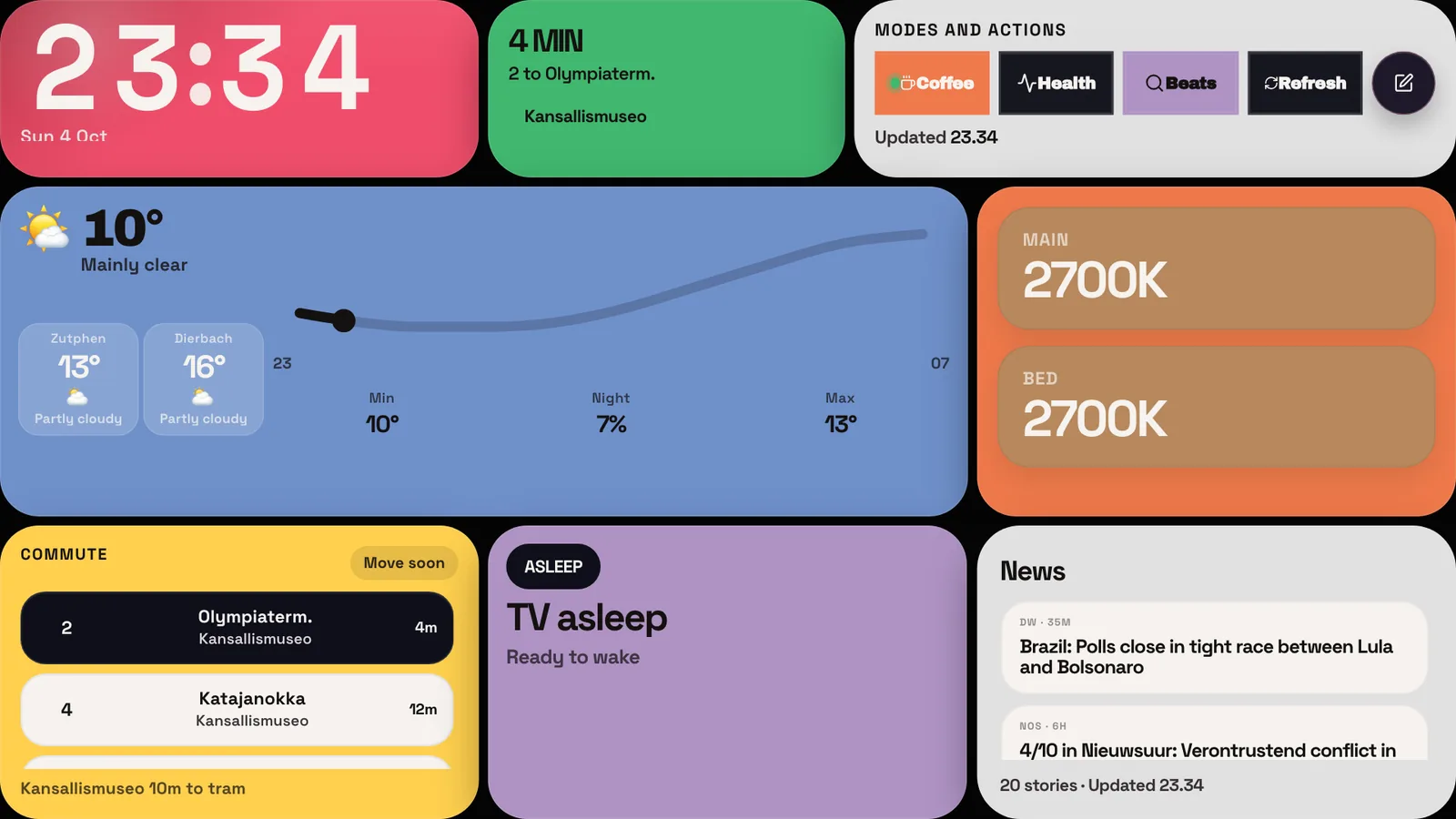
The layout, the app and its small server are mine, written with AI coding assistants. Home Assistant switched the lamps and the TV; tram times came from Digitransit and the weather from Open-Meteo.
The still above was rendered from the dashboard’s own code in October 2026, with the two lamp readings supplied and the tram stops replaced.
My workDesign and code: the layout, the app and its server.
WhenMarch to July 2026
Decision / Interface
Read at a glance, not studied.
I drew it as a black board with bold tiles and giant numerals, meant to be read from across the room.
Its main modes are ambient, media, lights, commute, news and weather. It never shows the same information twice, and no tile is labelled with what it obviously is.
The layout keeps to a 12-column grid with a few fixed spans, so the screen stays systematic rather than improvised tile by tile.
Build / Pi and server
How it was built.
A Raspberry Pi ran Home Assistant and the dashboard, on a 7-inch touchscreen in landscape.
The dashboard is plain JavaScript built with Vite, served by a small Python server with private endpoints, so the health data’s key stays on the server.
- Screen
- 7-inch touchscreen, 1280 × 720, landscape
- Dashboard
- Vite · plain JavaScript · Python server with private proxy endpoints
- Data
- Home Assistant · Digitransit · Open-Meteo · news feeds
Also at home: I’ve been modifying my coffee machine with Gaggiuino ↗, the community-built, open-source control system.
Sources: the dashboard’s repository and its notes (commits from 20 March to 23 July 2026); none is public. The still was rendered from the dashboard’s own code in October 2026. The demo’s news is placeholder text: it does not copy the feeds.