Earlier work / Wi-Fi 6E / Field tests
How much data can reach the ground before the aircraft takes off again?
An air taxi has a short stop between flights to hand over its onboard data. For my bachelor’s thesis I investigated a Wi-Fi 6E link for that handover: how distance, altitude and reflections change it, and what the new 6 GHz band adds to 2.4 and 5 GHz.
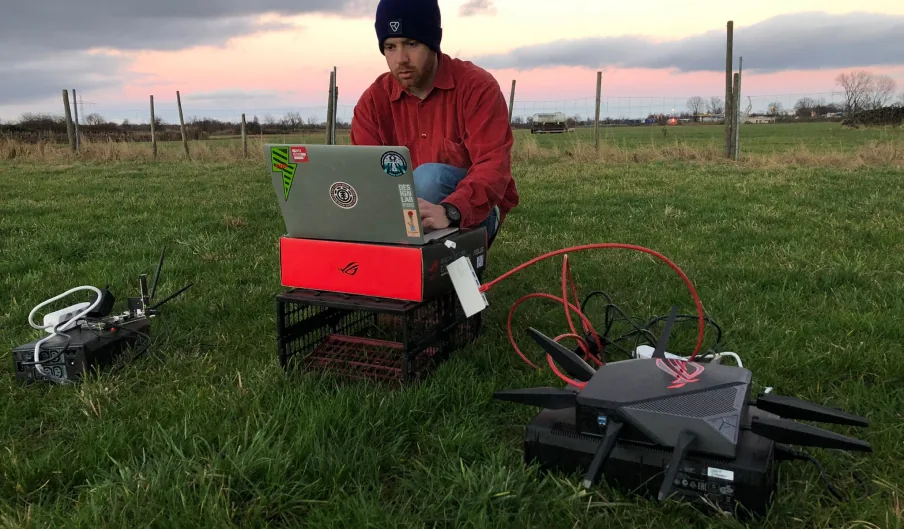
I built the radio test setup, simulated the antennas and took the link outdoors, with the radios carried by drones.
The specific results belong to Volocopter and are not published here.
My workWorking student, Digital Platform, and my BSc thesis in Electrical Engineering at the University of Twente
When and where2021 – 2022, Volocopter, Bruchsal
Decision / Bench
In autumn 2021, the 6 GHz band was open in Germany on paper only.
Germany had opened the lower part of the band, 5945 to 6425 MHz, in July 2021. When I started that autumn, I could get neither a driver nor hardware to use it with a German country code.
The radio card takes its allowed channels from the country code that nearby access points broadcast, so setting it to the US by hand changed nothing.
The workaround suggested on Intel’s community forum was a room where the card hears only one access point, configured for the US. Mine was a cellar.
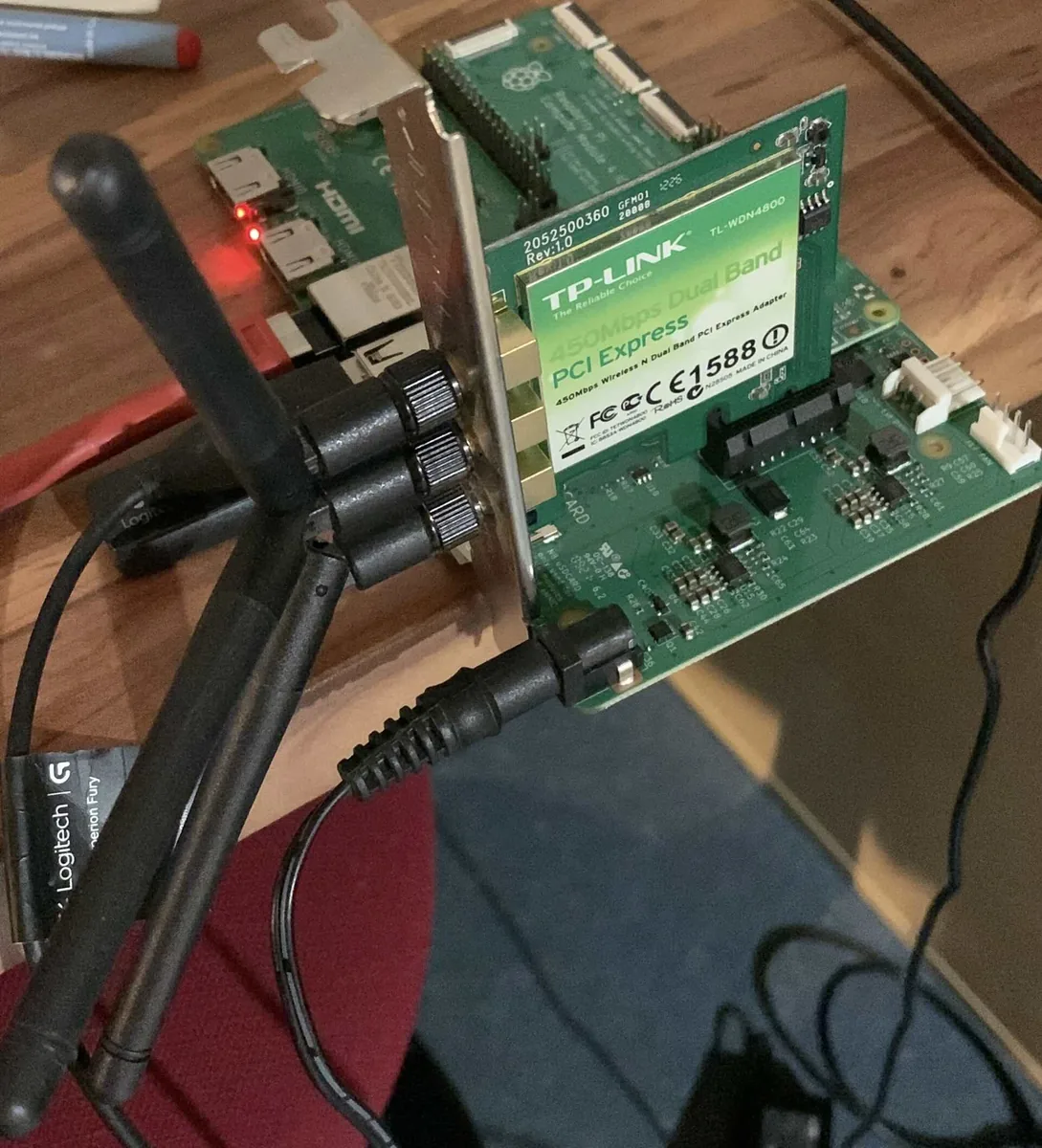
Intel’s Linux driver for the AX210 needs PCIe, and the Raspberry Pi 4 has no PCIe slot to put the card in. So the setup moved to a Raspberry Pi Compute Module 4 on a carrier board with a PCIe slot, and I patched its kernel.
pi@raspberrypi:~ $ iwconfig wlp1s0
wlp1s0  IEEE 802.11  ESSID:"Volocopter6G"
        Mode:Managed  Frequency:6.535 GHz
        Bit Rate=490 Mb/s   Tx-Power=22 dBm
        …
        Link Quality=70/70  Signal level=-30 dBm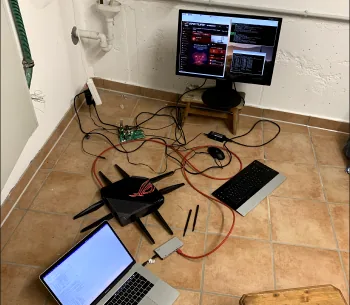
Method / Simulation and field
From simulated antennas to a link in the air.
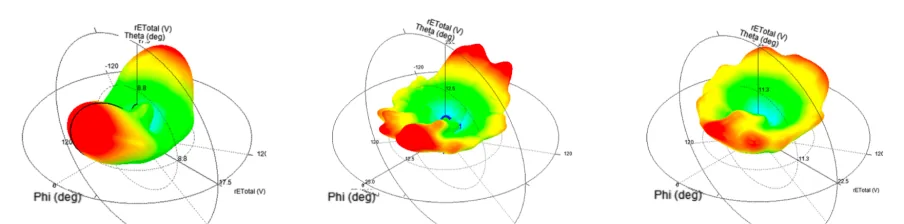
I simulated 4×4 MIMO antennas in Ansys HFSS: where they radiate, how strongly, and how the elements affect each other.
The link analysis compared modulation schemes from QPSK to 1024-QAM: how much each radio symbol carries, and how noise affects the error rate. A Rician fading model stood in for the ground-to-air channel.
In the field, the link was measured against altitude, distance and reflections, with the radios carried by drones.
- Radios
- Intel AX210 on Raspberry Pi Compute Module 4 carriers
- Bands
- 2.4, 5 and 6 GHz compared
- Simulation
- Ansys HFSS · 4×4 MIMO
- Results
- Volocopter’s; not published here
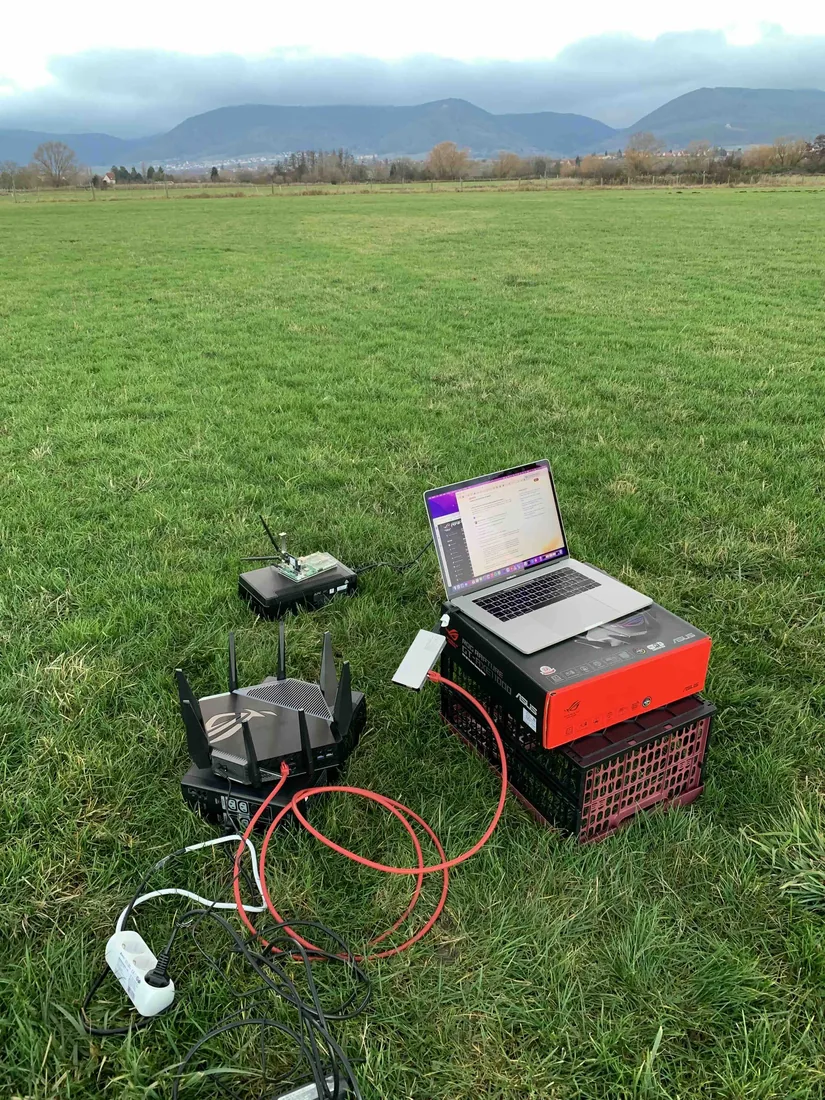
Sources: my thesis notes from 2021 and 2022, a photo of the radio’s screen, and the project photographs. The thesis results belong to Volocopter and are not published.